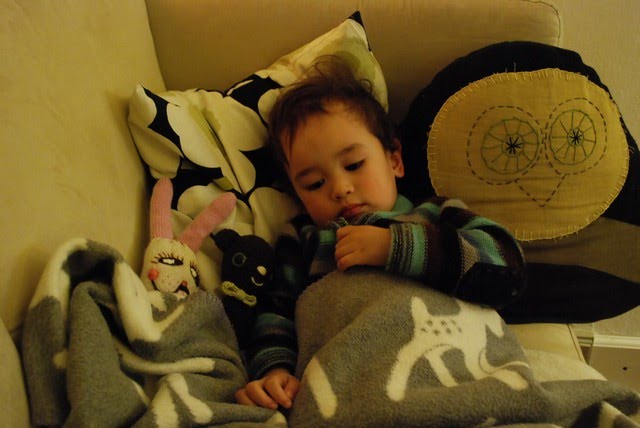
もうすぐ、モアモアにやってきます。 "-----屋根裏部屋で、おもちゃの兵隊たちやオルゴール、駒たちの中で、私は、Otto Kajak オットー・カヤックという名前の年取ったトム・キャットにつまずいて転びました。彼は1920年代の昔、かつて仕立て屋として腕をならしていた頃に姿を消して以来、そこに隠れていたんです。オットーは、私たちの父母、そして祖父母が子どもたちだった日々の、職人技、美しいデザイン、素晴らしい品のことを教えてくれました・・・・・ この物語が、私たちのインスピレーションとなって、2009年の秋、私たちは、オットー・カヤックという名の、洋服のブランドを立ち上げたのです。" Beautiful, subtle and charming children's clothes by Otto Kajak - it certainly reminds the children's exciting adventures and fairytales found in the attic....
"In an attic, in an old box of toy soldiers, music boxes and spinning tops, we stumbled at an old tomcat named Otto Kajak. He had been hidden away since the 1920´s, where he had his glory as a tailor. The last few years, Otto has taught us about quality, craftsmanship and fine designs, from the days when our grandparents and parents were children. All this has inspired us to start our own exclusive clothing brand, Otto Kajak, which launched in Autumn 2009."
My little boy Gustav is playing outside, enjoying the soft breeze, feeling the spring sun, touching the earth. I can feel how much children love to play outside, and feel the nature. Children in Fukushima, and also areas around, are not able to feel the wind, play freely outside anymore. Also in Tokyo, some are scared to let the children play outside, as people cannpt rely on the information from the government.
Even after Fukushima nuclear power plant's accident, the Japanese government has announced that they will continue to push nuclear power as a national industry, and continue the export of the nuclear power plants to the developing countries. India and Vietnam had confirmed that they will continue importing the nuclear power plants from Japan. And many people are not aware of the possibility of the renewable and natural energy - so even though people are feeling in real, that the nuclear power plants are never free of the risk of the radioactive contamination, some people still believes it is the only solution to prevent the global warming, in connection with the CO2 emission. Some Japanese people also believes that the nuclear power is the only way to get enough energy to keep the economy.
The grid in Japan is not owned by the citizens, but it is owned by the few dominating electronic companies including TEPCO (the biggest electricity company in the world, who owns nuclear power plants in Fukushima). So even some companies and people were willing to invest on the renewable energy, they were not able to connect to the grid and sell the energy freely - as TEPCO is the owner of the grid.
There has never been a national vote on our enerygy policy. During the cold war, there has been a political and economical aim, between Japan and U.S., to make nuclear power plants in Japan. The dark root has been so deep.
There has been a clear proof that some scientists, specialists, nuclear power plant architects who has been pointing out the danger of the power plants in Japan, in connection with the earthquake, tsunami, and also its deterioration. But it has been neglected by TEPCO and the ministry of the economy.
People who has protested for the nuclear power plants, has been pushed away, by the police, or neglected by the government.
The democracy in Japan seems not functioning, and too much corruption is seen in the politicians and the people who has the strong power, in connection with owning the dominating companies in Japan.
I am a Japanese who lives in Denmark, a country which has determined nuclear powerplant as illegal in 1988, and since then the national concensus and the policy has headed to invest and develop the renewable energy . Now the country earns 20% of its energy from the wind power, exporting its 23% of electricity, and decreasing CO2 emmisions for 13.3% compared to the 90's, and at the same time making stable economical growth every year. Denmark has the higest GDP per 1KWh compared to any countries in EU, and declared to make the country free from fossil fuels by 2050.
Iceland is producing most of its energy from geothermal energy, and can produce twice as much electricity which Japan is consuming.
Japan has the world 3rd largest resources when it comes to the geothermal energy, but it has never been focused, as the government has been pushing the nuclear power plants as the national energy policy.
As a Japanese, who is a mother, wishing the best for children in the world, - I feel that I must introduce how the energy policy in Denmark has been successful. The paragraphs and the article I have written in below, in Japanese, describes how Denmark has made big development in the renewable energy, how Japan has ended up having 54 nuclear power plants, and what has been preventing Japan to develop renewable energy, What can we learn from Denmark and Icaland, How can Japan would gradually move away from the nuclear power plants and shift the enerygy policy, pros and cons of the nuclear power plants.
I also invesigated the difference of the electricity fee that Danish people and Japanese people pays, what you can see by the difference - how much auctaully the dominating electricity companies in Japan are earning - which is a lot.
I beleive that the country such as Denmark has made a great show case for the world, how it is possible to not be dependent on nuclear power plants, make less CO2 emissions, but at same time has sufficient energy, and make economical growth at the same time. People might point out that those countries was successful due to its small population - but I believe that was not the only reason of their success. There are also many reasons behind, which is useful for other countries with big population.
Nuclear power plants are not our solution to prevent the global warming - even though people might say that it does not make much CO2 emmission, it does always have a risk of radioactive contamination. People should be aware what is the message behind the speech of the politicians. No one, including the architect of the nuclear power plant can never assure 100% that it is safe or free from an accident or being a target of terrorism. And once the accident happens, the risk is too huge - and ones who would be the victim, is always the most little ones - the babies in the mother's stomach, babies and the small children - they are not the ones who made the nuclear power plants - but they are the ones who would inherit the danger, risk and the contamination.
Gustav loooves his freind Kirian. Whenever he comes and visit us, Gustav starts dancing by joy. Kirian's mom Maki has been taking care of Gustav whenever we have to work away from home, until late.She had supported us so much. Thank you Maki chan and Nick san...♥
Two little boys are so happy playing, giggling together. When I see them, I pray even more stronger, that all the children, in Japan, in the world, to have happy and safe life.......
I have noticed, how big it was, the number of the victims in Sumatra earthquake. I have noticed, how I was too ignorant to many tragics happening in the world. The earthquake and tsunami in Japan made me notice many things..
Japan must change.
Denmark, which has determined nuclear powerplant as illegal in 1988 has been investing, developing and using renewable natural powers - such as wind mill, geothermal energy and biofuels - by the political support and the concensus of the nations. Danish government has announced that this country would be free from fossil fuels in 2050.
Japan has signed "Japan‐United States Atomic Agreement" since 1968. Together with the U.S., under the propaganda to use nuclear power for peaceful purpose and that nuclear power plant is CO2 freindly (it produces less CO2 than thermal power, fossil fuels - but nuclear power plant does produce CO2), Japan has been proceeding nuclear power as the national industry. Even after the Fukushima accident, Japanese government is announcing that they will continue exporting nuclear power plants to abroad, such as India, Vietnam and Turkey. The Indian government has announced that "There are nobody who would stop producing cars just because there has been accidents. Therefore we will continue proceeding nuclear power plants after the accident".
It has been difficult to get national consensus to make big investment on ecological power plants in Japan - by many reasons. Its relationship with U.S., bureaucracy, ignorance by citizens, the dominating and manipulating electricity company, corruption, the unefficiency and unclear politics of tax usage, etc etc...
There has been big opposition towards ecological power plants, for example, that ecological power plant such as wind mill is too unstable compared to nuclar power plant, thus it is not enough to support our economy. But there are ways to solve it, as shown in Denmark.
Furthermore, the grid is not aligned and not connected even between the east and the west in Japan, and also it is not owned by nation - instead it is owned by big electricity companies such as TEPCO (The company which owns the nuclear powerplants including The ones which is in accidents, in Fukushima) so in case of lack or rebundant electricity, there are no way to share the electrocity all over Japan. Furthermore, even how much some companies, people would invest on renewable natural energies, they could not sell the energy as they are not allowed to connect to the grid nor sell them to big electricity companies - as it has been only up to the owner of the grid, who is the big electricity companies. On the other hand, in Denmark and E.U., grid are connected and owned by nation - thus it is possible to maintain stable supply from ecological power plants, and the will of the nations is possible to be reflected to the choices of energy. In Japan, many of the top people of the big companies are shareholders of TEPCO, and there are many politicians who are granted good jobs in TEPCO after retirenment. Many of the TV companies are sponsored by TEPCO. So the clear information, criticism of the nuclear powerplants has often been hidden or smashed. Many of the voices which had claimed the danger of the nuclear power plant, also in the connection with earthquakes, had been just ignored. For example, in 2009, the head of the earthquake investigation center, Yukinobu Okamura had claimed that the "Jyogan earthquake" which happened 1100 years ago in Miyagi ocean with Tsunami, could happen soon, as it was investigated to happen every once in 450 -800 years - in a scale of more than maginitude 8. Also the earthquakes which had happened continuously, in a scale of the ones at Sumatra, has been predicted in Japan. Thus the report that Fukushima neuclear power plants are predicted to be not sustainable by the possible earthquake and tsunami - was submitted in 2009. But it was neglected by the ministry of economy.
And I feel that there are not enough knowledge of clean energy shared amongst Japanese citizen - many reasons can be guessed. We are an island country - although we are in this internet company, in the international world, many Japanese cannot read English, and it is different than being a country for example in Europe, where you are sorrounded by many countries. Citizens has been not interested enough in politics - our parents' generations had fought with government in 60-70's especially about how Japan has been obliged to the treaty with U.S. - but ended up failing, and after that there are "given-up" mood. The Japanese government was following treaty with U.S. for the nuclear power - there must be many who wanted to keep nuclear power and oppose to the new coming clean energy, to keep their rights and profits.
We ended up having 29% of our energy made by nuclear power plant. So it would be difficult to change right away . It would take time, effort, huge investment.
But I strongly believe we must pay the price in order to get the safe society, by investing in technology to spread the clean energy - such as biofuels, geothermal plant, wind mill, solar power, wave activated power, for the sake of children - in Japan, and in the world.
I believe we can learn a lot from Denmark and Iceland, countries with the most developed clean energy facilities. As a Japanese living in Denmark, I believe I can do a lot, to introduce how these countries had gained the clean energy.
I wish I could stop Japan to export nuclear power plants to India, Vietnam, Turkey, and many developing countries. Even the most advanced nuclear power plants cannot be free from possibility of accidents by itself - and furthermore, there are always a threat of terrorism or natural disaster. Even how much the risk percentage is small, once there is an accident, it could be an accident that we can never go back.
Another aspect I have noticed - 67% of Japanese women quit their carrier after delivering baby. 38% of the politicians in Denmark is women. I was impressed when I found out that Denmark is pulled by the power of women. The main reason that I have chosen to work at Danish company (A.P. Møller) back then when I have graduated university was that I could not find any Japanese companies which was giving equal rights to women. I believe, we Japanese women must change - to lead our society, and contribute to society and politics.I think there are many aspects that women can sees different than men - we think of children, we think in longer term.
The democracy has not been deeply grown in Japan - as it did not came naturally in Japan. It was planted, or has been torn apart, or forgotten or corrupted in many ways.
There are many difficulties waiting. But we must change.
The world is gaining 16% of its electricity from nuclear power plants. I believe this is the time for all of us to change - nature has huge power by itself - sun, wind, waves, etc etc... Nuclear power plant is not CO2 neutral, and its risk is too huge compared to its advantage. And even if we will be a little more free of CO2, we will be stuck by Plutonium instead anyway.
And when there are pollution of radiation, the risk is always the higest for baby, children - although it is not them who made the nuclear power plants.....how tragic can that be?
Our wisdom must be used for the renewable natural energy, instead of being stuck by the dangerous power - for the sake of our children and the earth.
Here are the quote from The New York Times, written by Japanese novelist Ryu Murakami.
"......Ten years ago I wrote a novel in which a middle-school student, delivering a speech before Parliament, says: “This country has everything. You can find whatever you want here. The only thing you can’t find is hope.”
One might say the opposite today: evacuation centers are facing serious shortages of food, water and medicine; there are shortages of goods and power in the Tokyo area as well. Our way of life is threatened, and the government and utility companies have not responded adequately.
But for all we’ve lost, hope is in fact one thing we Japanese have regained. The great earthquake and tsunami have robbed us of many lives and resources. But we who were so intoxicated with our own prosperity have once again planted the seed of hope. So I choose to believe."
Tak fordi du besøger min blog. Dansk Røde Kors har startet en indsamling til fordel for Japan. Mange børn har mistet deres forældre og mange mennesker har mistet alt. Ræk disse medmennesker en hånd og støt Dansk Røde Kors indsamling via dette link: http://www.drk.dk/nyheder/nyheder/det+er+naesten+ikke+til+at+fatte#